A clear night — Milky Way and aurora
The scenario. A forecast of clear skies later in the week, and a dark-sky location an hour away. Whether that is worth the drive depends on about five things, and four of them have nothing to do with cloud.
Night photography has more constraints stacked on top of each other than any other kind, which makes it the thing most worth checking before setting off.
1. Is it dark enough at all?
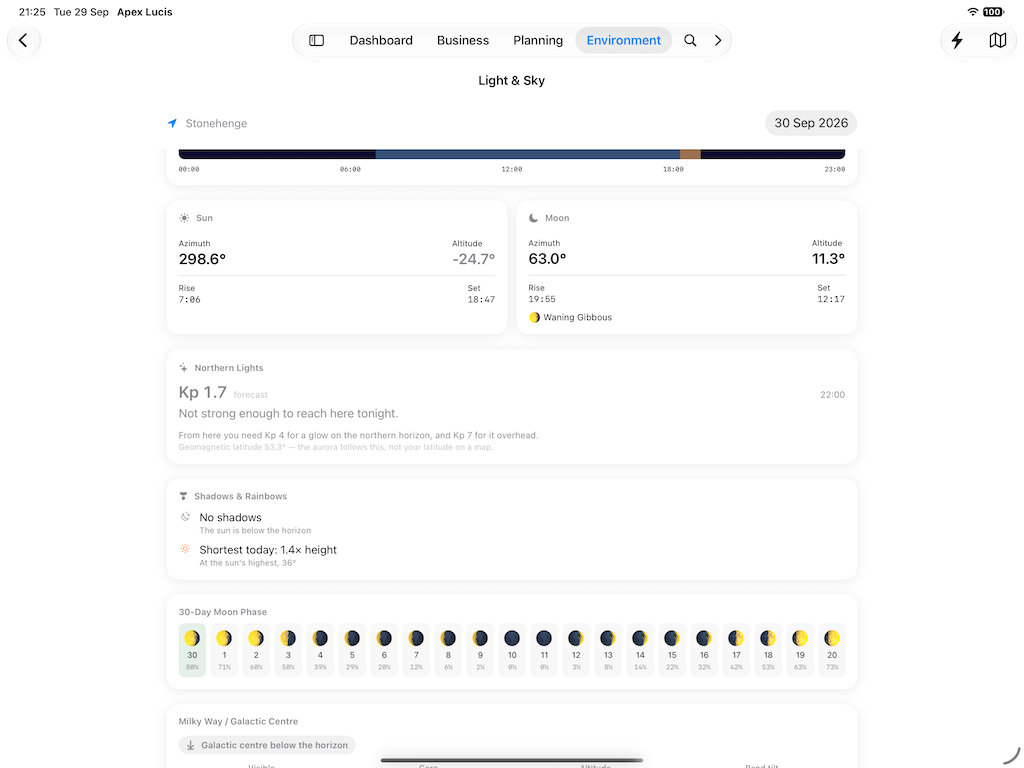
Environment → Light & Sky
The phase to look for is astronomical twilight — the sun 18° or more below the horizon. Before that boundary the sky is not dark enough for the Milky Way, whatever it looks like to your eye.
This is also where northern latitudes run out of options. In midsummer the sun never gets 18° below the horizon in northern Britain, so astronomical night simply does not occur and no amount of clear sky will help. The app says so rather than offering you a window that cannot exist.
Check when astronomical night starts and ends. In spring it may be a narrow band in the middle of the night; in winter it is most of it.
2. Where is the moon, and how full?
For the Milky Way you want no moon, which is a constraint people meet late.
A gibbous moon washes the sky out as effectively as light pollution. What you are looking for is either a new moon, or a night where the moon sets before astronomical night begins — or rises after it ends.
Light & Sky gives you moonrise, moonset and the illumination percentage, so the question becomes “is the sky dark and the moon down at the same time”, which is usually a handful of nights a month.
3. Where will the galactic centre be?
The bright part of the Milky Way — the galactic centre — is only above the horizon for part of the year, and only well placed for part of that.
Apex Lucis shows the band’s position and orientation for your location and time, so you can work out whether it will be standing upright over your subject or lying along the horizon behind you. That decides the composition entirely, and it is not something you can guess from a star chart in the car.
Roughly: spring for a low arch before dawn, summer for the core high in the south, and nothing worth driving for in midwinter from northern latitudes.
4. Aurora — can it even reach you?
Environment → Light & Sky → Aurora
The aurora question is a comparison: how far the auroral oval pushes toward the equator against where you are, both in geomagnetic latitude — which is not the latitude on the map.
Apex Lucis works out the smallest Kp — the 0 to 9 measure of geomagnetic disturbance — that would bring the aurora to your location. Two useful things come out of that:
Whether it is possible at all. For much of the world no storm on the scale reaches, and the honest answer is given rather than a permanently empty forecast.
Horizon versus overhead. These are different photographs needing different lenses and completely different foregrounds. The aurora is a curtain a couple of hundred kilometres tall, so it clears the horizon well before it is overhead — and roughly two degrees of latitude per Kp step means a storm two steps above your local threshold is the difference between a glow low in the north and something directly above you.
If you are far enough north for it to be realistic, the aurora alert is worth switching on. It is one of the few genuinely time-critical things in photography.
5. Then, and only then, the forecast
Environment → Weather
Cloud cover for the hours you would actually be out, not for the day.
Night work is the one case where clear really is what you want — the usual advice about broken cloud making better sunsets does not apply when the subject is the sky itself.
Check the temperature too. A four-hour session at 2°C needs different preparation from the same session in August, and dew on the front element ends a night quickly.
6. The location
Planning → Locations
Dark-sky locations are usually remote, and the notes matter more than anywhere else: where to park, how long the walk is in the dark, whether a gate is locked overnight, whether the ground is safe to cross without light.
Add a reference photograph taken in daylight. Recognising your composition at midnight from a daytime record shot is far easier than finding it from memory.
What a good night looks like
All five lining up: astronomical night that actually occurs, no moon in it, the galactic centre where you want it, clear sky, and a location you can reach and walk. That is why it is worth checking rather than hoping — the combination is rarer than any individual part suggests.
Modules used
| Module | Guide |
|---|---|
| Light & Sky | Light & Sky |
| Weather | Weather |
| Locations | Location Scout |
| Notifications | Notifications |
| Bookings | Bookings |